The combustion engineering within modern hydronic appliances requires an exact, mathematically measured ratio of fuel and air to generate an efficient, soot-free flame. This delicate metering duty is executed by high-precision brass orifices termed boiler burner injector components, universally referred to across the trade as the boiler gas nozzle assembly. Microscopic restrictions within these brass orifices cause severe thermal efficiency degradation and trigger a persistent boiler low flame fault. Furthermore, amateur mechanical tampering frequently results in incomplete combustion and lethal carbon monoxide spillage. Understanding the hydrodynamic principles distinguishing boiler natural gas vs LPG configurations is the single most vital competency required when converting boiler to LPG supplies.
What are Boiler Burner Injectors and How Do They Work?
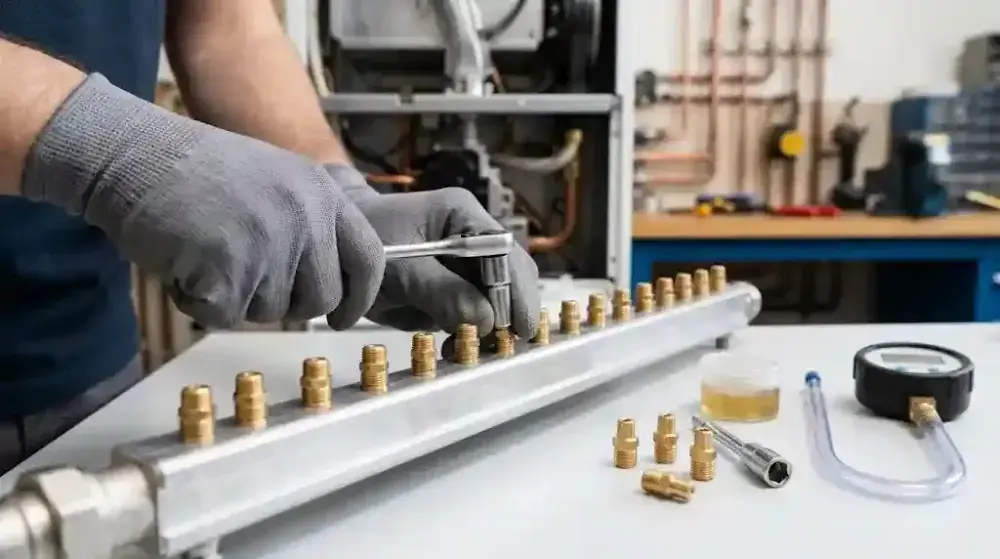
A boiler burner injector (or boiler gas nozzle) is a precision-machined brass fitting threaded directly into the fuel distribution manifold (gas rail) positioned immediately beneath the burner aerators. Modern domestic combi boilers typically integrate between 11 and 15 identical nozzles depending on total kilowatt output ratings. The operational purpose of the boiler gas nozzle is accelerating raw fuel into the burner venturi throat: Kinetic Energy Amplification: As pressurized fuel exits the modulation valve and enters the tiny orifice of the boiler gas nozzle, it undergoes an abrupt pressure drop coupled with massive velocity acceleration. This high-speed stream creates a localized depression (Venturi principle), entraining primary combustion air directly into the burner body. Micro-Metering Fuel Volume: The internal diameter of the boiler burner injector governs the exact volume of fuel delivered per second. Factory tolerances are held to hundredths of a millimeter, engineered precisely to the appliance's thermal rating (such as 24kW or 28kW). Segregation from Regulation Valves: While the gas valve regulates overall manifold pressure and safety shutoff, individual boiler burner injector ports provide localized fuel distribution into each burner blade to prevent localized thermal stress.
Boiler Natural Gas vs LPG Configurations and Conversion Protocols
A frequent requirement in rural residential installations is converting boiler to LPG tank or cylinder networks. Executing this transition legally and safely demands swapping every installed boiler gas nozzle with certified liquid petroleum gas equivalents. Neglecting to replace the nozzles when switching fuel types causes catastrophic fire hazards, heavy sooting, or dangerous appliance lockouts. Nozzle Orifice Diameters: Evaluating boiler natural gas vs LPG parameters reveals that LPG carries a significantly higher calorific density and operates under higher delivery pressures. Therefore, the physical bore of an LPG nozzle must be substantially smaller (approximately 0. 77mm for LPG compared to 1. 30mm for standard Natural Gas). The Hazards of Mismatched Orifices: If a natural gas unit is operated on bottled propane without converting boiler to LPG components, the oversized bore permits excessive fuel volumes into the combustion chamber. This produces roaring, uncontrolled yellow flames that warp the primary heat exchanger and generate heavy soot deposits. Gas Train Re-commissioning: Beyond physical nozzle replacement, converting boiler to LPG requires setting minimum and maximum burner pressures on the gas valve using a digital manometer to balance heat input and prevent incomplete combustion.
Diagnosing a Blocked Boiler Injector and Low Flame Faults
Over operational heating cycles, technicians frequently observe that despite normal inlet gas pressure, burner flame height remains severely depressed, indicating a classic boiler low flame fault. This condition is almost invariably caused by a blocked boiler injector. The development of a blocked boiler injector and subsequent boiler low flame fault symptoms occurs through specific mechanisms: Fuel Supply Contaminants: Heavy hydrocarbons, pipe dust, and rust scale travelling through public distribution networks pack tightly behind the nozzle bore, leading directly to a blocked boiler injector. Heat Exchanger Exfoliation: On aging heating appliances, metallic flakes shedding from the exterior fins of the copper heat exchanger drop downward, resting over the exit holes of the boiler gas nozzle row. Asymmetric Flame Geometry: When evaluating a suspected blocked boiler injector, visual inspection typically reveals uneven burner behavior; several burner sections sustain normal flame height, while blocked ports exhibit an obvious boiler low flame fault or fail to ignite entirely.
Workshop Guidelines for Cleaning Burner Nozzles Safely
Performing maintenance and cleaning burner nozzles demands extreme technical discipline. Distorting or reaming the calibrated bore by even fractions of a millimeter destroys stoichiometric air-fuel mixing and produces dangerous carbon monoxide emissions. To ensure safety while cleaning burner nozzles, strictly adhere to the following procedures: Prohibition of Metallic Probes: Never utilize welding tip cleaners, needles, or steel wires when attempting to clear a blocked boiler injector. Hardened steel gouges the soft brass orifice, ovalizing the bore and worsening the boiler low flame fault into severe unburnt fuel spillage. Immersion Chemical Washing: Demount the gas manifold completely from the chassis. Extract each boiler burner injector utilizing a dedicated socket wrench (typically 7mm). Submerge the nozzles in an approved degreasing chemical or cleaning solvent to dissolve baked hydrocarbon residues. Pneumatic Clearing: Following solvent treatment, complete the process of cleaning burner nozzles by purging internal passages with clean, dry compressed air. Reinstall the nozzles onto the gas rail without over-torquing to prevent stripping brass threads.
Final Summary
The boiler burner injector assembly is the ultimate precision boundary governing fuel delivery before ignition. Maintaining an unobstructed boiler gas nozzle row guarantees a clean, stable blue flame. Obstructions caused by supply pipeline debris lead directly to a blocked boiler injector, causing chronic low heat transfer and an undeniable boiler low flame fault. Technicians engaged in cleaning burner nozzles must avoid mechanical reaming tools and employ dedicated chemical wash and pneumatic flush procedures. Finally, when converting boiler to LPG supplies, adhering to the distinct orifice criteria of boiler natural gas vs LPG systems and recalibrating the gas valve ensures optimal efficiency and absolute operational safety.