
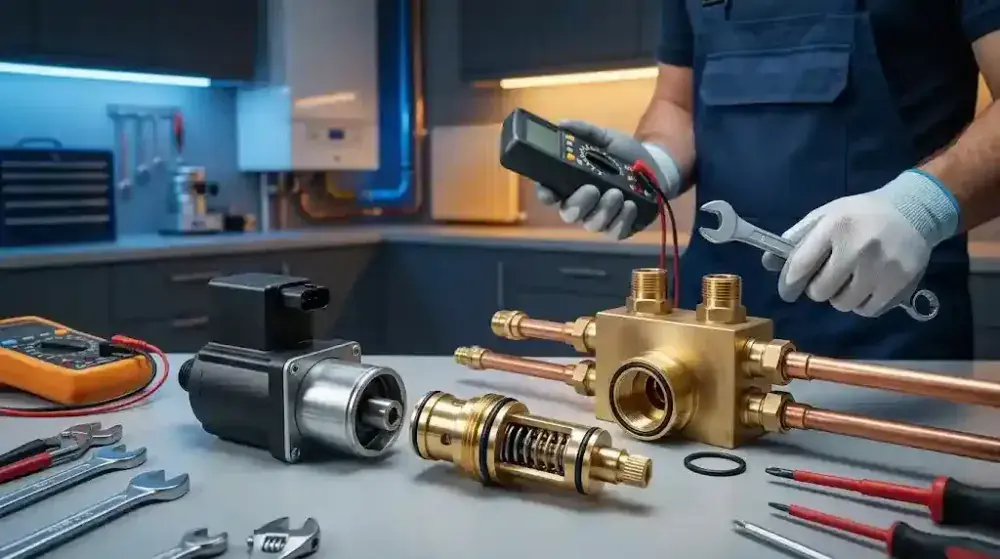
Accurately routing the flow of water in a combi boiler is the responsibility of a critical electromechanical component: the boiler motorized diverter valve. Acting as the railway switch of the hydraulic block, it dictates whether the burner's thermal energy is sent to heat the radiators or diverted to the secondary heat exchanger for domestic hot water. Understanding how this actuator operates and successfully isolating electrical faults from mechanical ones is a core skill for any technician performing boiler diagnostics.
What is a Boiler Diverter Valve and How Does It Operate?
A boiler diverter valve is a dual-component assembly comprising an electrical actuator motor and a mechanical brass cartridge containing a plunger. Its primary purpose is to exclusively direct hot primary water either to the central heating (CH) circuit or the domestic hot water (DHW) plate heat exchanger. This component is controlled directly by the main printed circuit board (PCB) and operates strictly on a domestic hot water priority basis. DHW Priority: The moment a hot tap is opened, the flow switch alerts the PCB, which commands the actuator motor to extend its spindle, completely blocking the central heating pathway. Central Heating Mode: When the tap is closed, the motor retracts, allowing the internal cartridge spring to open the pathway back to the building's radiators. Modular Design: The assembly is structurally split into an electrical motor (usually 230V or 24V) and a wet mechanical diverter valve cartridge installed directly into the brass manifold.
Causes of Diverter Valve Failure and Cartridge Seizing
One of the most challenging diagnostic tasks is finding the root cause of a boiler diverter valve sticking. In most scenarios, the electrical motor hasn't burnt out; rather, heavy limescale accumulation causes the mechanical spindle to bind mid-cycle. Poor water quality and lack of system inhibitors directly destroy this component's functionality. Cartridge Scaling: High water hardness in the primary circuit deposits calcium layers on the brass spindle, jamming its linear movement and causing the valve to seize. Water Ingress to the Motor: Degradation of the internal cartridge O-rings allows high-pressure water to leak upward, short-circuiting the electrical actuator motor. Spring Fatigue: If the internal return spring loses its tension, the plunger cannot fully close off the radiator pathway even when the motor commands it to do so.
Primary Symptoms of Diverter Valve Faults in Combi Boilers
When this component fails to route water correctly, it creates highly noticeable thermal behavioral anomalies. Technicians can often diagnose a boiler diverter valve sticking simply by touching the flow and return pipes underneath the chassis. The most prominent indicators of a failing diverter assembly include: Radiators Getting Hot in Summer: If the central heating flow pipe becomes hot while a user runs the shower, the diverter valve has failed to seal the heating port completely. Combi Boiler Hot Water Only Reaching Tepid Temperatures: A partially open radiator port means the thermal energy is split, preventing the secondary heat exchanger from heating the domestic water fully. Overheating Lockouts: If the motor seizes halfway, circulation is severely restricted, causing the primary heat exchanger to boil and triggering NTC sensor or high-limit thermostat errors.
Safe Workshop Checklist for Testing Diverter Valve Motors
Before condemning the entire hydraulic block, conducting proper tests for testing diverter valve motor functions is mandatory to separate electrical and mechanical faults. Often, a boiler 3-way valve replacement merely requires swapping a cheap cartridge rather than the expensive motor. Adhering to workshop electrical safety protocols is vital during these procedures: Actuator Removal: Release the retaining clip and pull the actuator head off the cartridge. With the hot tap running, observe if the motor spindle successfully extends and retracts. Mechanical Plunger Test: Using the flat end of a spanner, push the brass spindle of the diverter valve cartridge inward; it should depress against spring resistance and spring back instantly without catching. Depressurization Before Replacement: If the mechanical cartridge is scaled and requires extraction, you must physically isolate the boiler's power and completely drain the primary heating circuit to zero bar.
Final Summary
The boiler motorized diverter valve is the central thermal distributor in combi heating systems. Issues such as lukewarm domestic hot water or radiators inexplicably heating up during summer are directly traced to a boiler diverter valve sticking or a failed actuator. By professionally testing diverter valve motor operations independently of the mechanical cartridge, technicians prevent unnecessary and costly parts replacements. Always execute a boiler 3-way valve replacement after draining the hydraulic system and utilizing OEM-specified EPDM O-rings.