
Understanding the engineering difference between a boiler surface vs. immersion NTC sensor is a foundational requirement in hydronic system design and electronic diagnostic analysis. The primary distinction between a boiler surface vs. immersion NTC sensor lies in their fluid contact interfaces and thermal response velocities: an immersion NTC features a threaded metallic probe directly wetted by the circulating fluid, achieving near-instantaneous thermal tracking within 1 to 3 seconds, whereas a surface NTC clips externally onto copper pipework, conducting heat across the pipe wall with a slight thermal lag. While both sensors utilize identical 10 kΩ resistive curves at 25°C, their mechanical packaging dictates their suitability across specific heating loops. Technicians troubleshooting domestic water temperature hunting or radiator modulation lockouts must understand these thermodynamic boundaries. Substituting a surface sensor for an immersion probe without considering the heat transfer delay inevitably degrades gas valve modulation. This engineering guide details thermal time constants, hydronic sealing standards, diagnostic procedures, and parts replacement rules.
Operating Principles of Immersion (Wet-Pocket) Boiler NTC Sensors
An immersion NTC sensor, often designated as a wet-pocket or threaded thermistor probe, encloses its ceramic semiconductor bead inside a fluid-tight brass or stainless-steel protective sheath. This probe threads directly into a tapped hydraulic port in the hydroblock, placing the sensing surface in direct physical contact with moving water. Direct fluid contact minimizes the thermal boundary layer, driving the thermal response time constant down to between 1. 5 and 3. 0 seconds. In domestic hot-water circuits, where sudden tap demand requires instantaneous gas burner adjustment, this rapid response prevents cold shower slugs. Installing an immersion probe requires male threaded couplings—typically 1/8-inch, 1/4-inch, or quick-fit retaining wire clips—sealed by an elastomeric O-ring under line pressure. At OJAA Industrial Group production facilities in Abbasabad Industrial Estate, immersion models like the stainless-steel OJ-NTCST utilize high-grade corrosion-resistant alloys and WRAS-rated EPDM seals to prevent galvanic oxidation and mineral pitting in aggressive domestic water supplies.
Operating Principles of Surface-Mounted (Clip-On) Boiler NTC Sensors
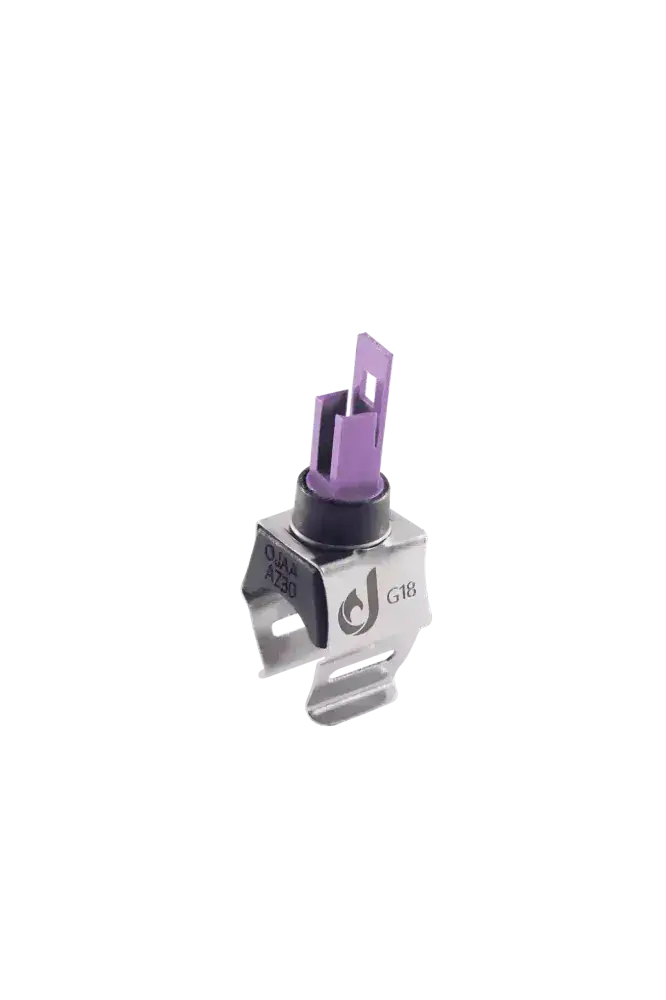
A surface-mounted NTC sensor, commonly referred to as a clip-on, pipe-clamp, or contact thermistor, secures externally to the outside perimeter of copper tubing. It makes zero intrusion into the internal fluid waterway. Thermal conduction occurs across an electroplated brass contact shoe held against bare copper by a high-tensile stainless-steel spring clip. The primary operational advantage of surface thermistors is serviceability: a failed sensor can be unclipped and replaced in less than two minutes without isolating building water lines, depressurizing the primary heating loop, or draining system glycol. However, heat must conduct through the copper wall, introducing a thermal time lag of 6 to 10 seconds. OJAA surface clip-on sensors are manufactured across G12 profiles for 1/2-inch pipes and G18 profiles for 3/4-inch pipes, available in socket-connected (OJ-G-18, OJ-G-12) and spade-terminal (OJ-18, OJ-12) layouts.
Engineering Comparison: Immersion vs. Surface NTC Sensors
Key operational differences between these two sensor platforms include: Thermal time constant and reaction speed: Immersion probes respond in 1 to 3 seconds; surface clip-on sensors require 6 to 10 seconds due to pipe wall thermal mass. Hydronic servicing and maintenance downtime: Replacing an immersion sensor requires draining circuit fluid and depressurizing; surface sensors unclip cleanly without hydraulic draining. Risk of hydroblock fluid leaks: Immersion sensors require sound O-ring compression to resist line pressure; surface sensors introduce zero hydraulic leak paths. Vulnerability to mineral scaling: Immersion probes accumulate insulating limescale coatings over time; surface sensors remain scale-free, though external copper oxidation must be cleaned. Thermal interface preparation: Immersion probes require no thermal paste; surface clip-on shoes require a thin layer of zinc-oxide thermal paste to eliminate insulating micro-air pockets.
Can a Surface Sensor Replace an Immersion NTC Sensor?
From an engineering and combustion safety standpoint, direct substitution is generally not permitted on domestic hot-water circuits. If an appliance firmware profile is calibrated for a fast immersion sensor, fitting a slower clip-on unit delays temperature feedback. The primary heat exchanger will ramp to excessive temperatures before the surface sensor registers the rise, resulting in hot-water scalding followed by thermal overshoot lockouts. Furthermore, removing an immersion probe leaves an open hydraulic port that must be sealed with a pressure-tight threaded plug. On primary central heating circuits where water volume is high and thermal changes are slower, external clip-on sensors can provide reliable service if pipe surfaces are polished and thermal compound is applied, but adhering to original factory specifications remains standard best practice.
Failure Symptoms: Immersion vs. Surface Thermistors
Operational anomalies manifest differently across these two physical formats: Immersion NTC failure signs: Weeping water leaks around the sensor threads or moisture bridging internal terminal pins. Delayed domestic hot-water stabilization caused by thick mineral limescale encrusting the probe tip. Corroded internal wiring caused by aggressive chemical flux or water migration across crimp seals. Surface NTC failure signs: Loose spring clips causing physical separation between the contact shoe and the pipe. Radiators failing to reach temperature because thermal conduction delay tricks the board into reading false overheating. Severe oxidation on copper tubing acting as an insulating barrier, causing continuous burner cycling.
Step-by-Step Multimeter Diagnostics
Regardless of mechanical housing, both sensor types share standard negative temperature coefficient behavior: Electrical safety: Isolate boiler mains power and disconnect wiring harness plugs from the sensor terminals. Multimeter configuration: Set the digital multimeter to the resistance scale at the 20 kΩ setting. Ambient baseline check: Measure resistance across terminals at room temperature; at approximately 25°C, a standard sensor reads approximately 10 kΩ. Dynamic test for immersion sensors: Submerge the metallic probe tip into a warm water container (around 50°C); resistance must drop rapidly to between 3. 5 kΩ and 4. 0 kΩ within 2 to 3 seconds. Dynamic test for surface sensors: Apply heat to the contact shoe; resistance must decline steadily without sudden open-circuit jumps. Diagnostic conclusion: Open-circuit readings, zero ohms, or erratic numerical spikes confirm internal ceramic failure, requiring component replacement.
Technician Evaluation Checklist for Replacement
When selecting a replacement boiler NTC thermistor, verify these engineering factors: Mechanical mounting architecture: Confirm threaded immersion ports versus external spring clip-on tubing. Probe material durability: Select stainless-steel sheaths like the OJ-NTCST for immersion applications in hard-water zones. Clamping geometry on surface units: Match G12 (1/2-inch) or G18 (3/4-inch) clip curves to conduit diameters. Electrical terminal interface: Match polarized locking plastic sockets or flat spade push-on terminals. Sealing integrity on wet probes: Install fresh WRAS-certified EPDM O-rings lubricated with pure silicone grease. Pipe preparation: Clean copper conduits down to bright metal and apply thermal compound before mounting surface sensors.
Final Summary
The difference between a boiler surface vs. immersion NTC sensor reflects distinct thermodynamic design priorities. Immersion probes provide rapid thermal response essential for stable domestic hot water, while surface clip-on thermistors provide safe, drain-free servicing across primary radiator circuits. Verifying mechanical port geometries, applying thermal compound to surface units, and conducting multimeter resistance tests ensures accurate temperature feedback, eliminates burner hunting, and preserves combi boiler heating comfort.