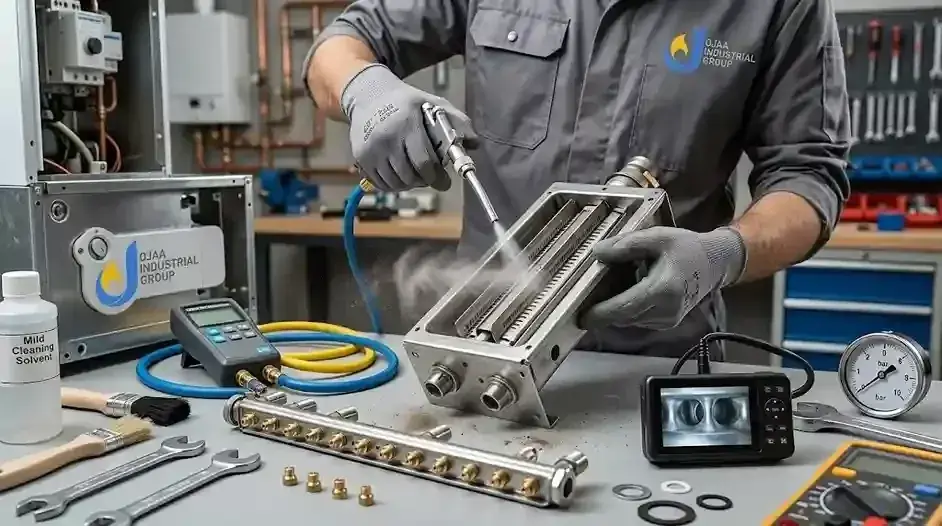
Producing safe and stable heat in a gas-fired boiler requires a highly precise mixture of oxygen and fuel. This critical aerodynamic process takes place within the boiler burner assembly. The integrity of the burner blades and the cleanliness of the gas injector nozzles dictate the appliance's thermal efficiency and prevent the deadly production of toxic gases. Over time, household dust blocking these microscopic pathways drastically alters the flame color and degrades combustion quality, necessitating specialized periodic servicing.
What is a Boiler Burner and How Does Gas-Air Mixing Work?
The boiler burner is a stainless steel or aluminized manifold featuring multiple rows of slotted blades, mounted directly at the base of the combustion chamber beneath the primary heat exchanger. The aerodynamic design of this component utilizes the Venturi effect to achieve optimal combustion. Gas Injector Nozzles: Regulated gas from the gas valve is forced at high pressure through microscopic orifices (injectors/jets) directly into the throat of each burner blade. Primary Air Induction: The high-velocity gas injection creates a localized vacuum at the base of the blades, pulling in fresh primary air (oxygen) to mix thoroughly with the gas before it reaches the surface. The Combustion Surface: The meticulously mixed gas and air exit through fine slots on the top surface of the blades, where the ignition electrode sparks to ignite a unified, clean blue flame.
Burner Blockage Symptoms and Causes of a Yellow Flame
Under standard operating conditions, a healthy boiler flame must be crisp, perfectly blue, and stable. A change in flame color is the very first and most critical warning sign of burner blockage and an incorrect gas-to-air ratio. Contamination within this component produces distinct visual and thermal symptoms. Yellow or Orange Flame: If pet hair, carpet fibers, or dust clogs the primary air induction ports beneath the blades, the gas burns without sufficient oxygen. This incomplete combustion produces a weak, lazy, yellow flame (fuel-rich mixture). Explosive Ignition: Blockages in the fine slots on the burner's top surface prevent the gas from distributing evenly. Unburnt gas pools in the chamber until it catches a spark, resulting in a frightening, explosive bang upon ignition. Soot and Gas Odors: Incomplete combustion caused by a dirty burner generates heavy black soot that coats the primary heat exchanger fins, often accompanied by a pungent odor of partially burnt gas around the appliance.
The Dangers of Neglecting Burner Service and Carbon Monoxide
Ignoring the need for periodic burner servicing and allowing the boiler to run with a yellow flame poses irreversible risks to both property and human life. Incomplete combustion directly generates lethal carbon monoxide (CO) gas. The destructive consequences of a neglected burner include: Silent Asphyxiation Risk: The excessive production of carbon monoxide from a fuel-rich flame can overwhelm the flue extraction system, allowing this deadly, odorless gas to spill back into the living space. Insulating the Heat Exchanger: The black soot produced during incomplete combustion settles on the copper fins of the primary heat exchanger. Soot acts as a powerful thermal insulator, preventing water from absorbing heat and causing the boiler to overheat and lock out. Melting Stainless Steel Blades: If the gas-air mixture ignites inside the throat of the blade (burner flashback) rather than on the surface, the concentrated extreme heat will permanently melt and deform the stainless steel structure.
Safe Workshop Checklist for Cleaning the Boiler Burner
Cleaning the boiler burner is a sensitive workshop procedure that mandates strict adherence to gas safety protocols. Any physical damage to the injector nozzles or burner slots will permanently destroy the appliance's combustion efficiency. Technicians must follow these steps to ensure a safe and effective service: Absolute Gas and Power Isolation: Before opening the sealed combustion chamber, physically unplug the boiler from the electrical mains and fully close the primary gas isolation valve beneath the appliance. Compressed Air and Water Washing: Detach the burner from the gas manifold. Wash the blades using lukewarm water and a soft nylon brush (never use wire brushes). Afterward, use an air compressor to blow all moisture and dust out of the internal blade throats. Do Not Tamper with Injectors: The holes in the gas nozzles are precisely calibrated to fractions of a millimeter. Never use needles, pins, or drill bits to clear them, as enlarging the orifice will cause severe over-gassing and highly dangerous combustion. Mandatory Leak Detection: Upon reinstalling the burner to the gas manifold, it is absolutely mandatory to test all gas joints using an electronic sniffer or approved leak detection fluid to ensure zero leakage.
Final Summary
The boiler burner is the beating heart of heat production, requiring a mathematically precise combination of gas and oxygen. The primary cause of a yellow boiler flame and explosive ignition is the blockage of the burner's air induction pathways by household dust and lint. Incomplete combustion not only plummets the appliance's thermal efficiency by creating soot but also introduces the extreme danger of carbon monoxide production. Servicing and cleaning the boiler burner must be conducted annually by certified technicians using compressed air and soft brushes, followed by rigorous gas leak testing to guarantee operational safety.