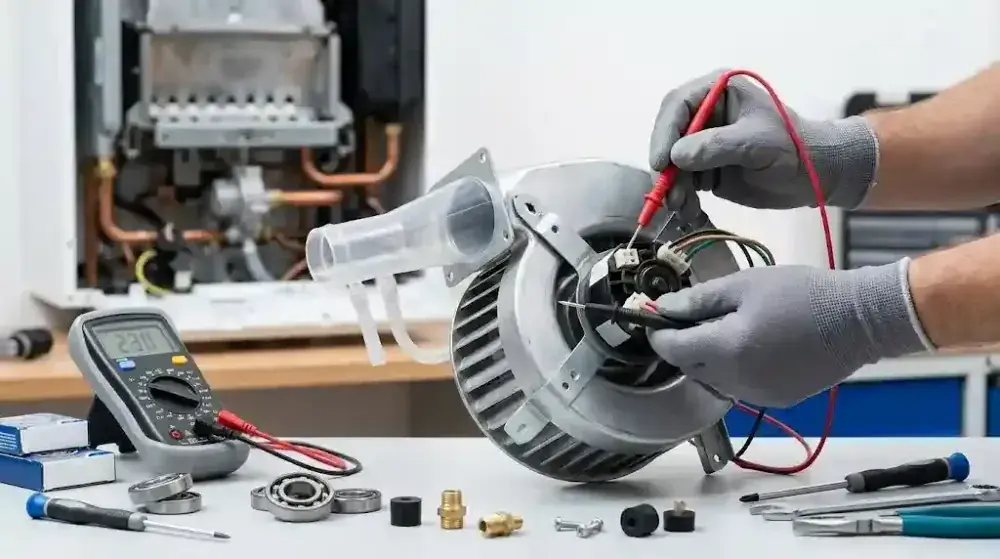
The combustion safety of room-sealed combi boilers relies entirely on the flawless execution of the flue gas extraction system. The boiler exhaust fan acts as the lungs of the appliance, pulling in fresh oxygen while forcibly expelling deadly carbon monoxide gases outside the property. When this centrifugal motor fails to start or suffers a drop in RPM due to worn bearings, the safety sensors immediately trigger an appliance lockout. Mastering the diagnostics of both the mechanical bearings and the electrical control relay is crucial for technicians ensuring safe combustion.
What is a Boiler Exhaust Fan and Its Flue Role?
A boiler exhaust fan is a specialized centrifugal blower motor installed at the very top of the sealed combustion chamber, connecting directly to the coaxial flue terminal. This component creates the negative and positive pressure differential required for clean, safe combustion. Simultaneous Airflow: In fan-assisted boilers, the aluminum impeller pulls fresh air through the outer flue duct while blasting hot, toxic carbon monoxide out through the inner duct to the atmosphere. Venturi Connection: Positioned on the fan's discharge port is a plastic or alloy Venturi tube. As air rushes past it, it generates a vacuum that physically triggers the air pressure switch. Stator Cooling: The 230V electrical motor is mounted outside the hot gas pathway. A small plastic cooling fan attached to the rear of the shaft prevents the stator coils from overheating during extended operation.
Causes of the Boiler Fan Not Starting and Air Pressure Faults
One of the most frequent faults technicians encounter is a flue extraction error (e. g. , E03). Diagnosing a boiler fan not starting requires carefully separating mechanical motor failure from the absence of an electrical command from the main Printed Circuit Board (PCB). Several distinct factors can prevent this critical safety component from initiating. PCB Fan Relay Failure: The small glass or black relay on the main PCB responsible for switching 230V power to the fan can suffer from arcing and burnt contacts, stopping the voltage transmission completely. Burnt Stator Coils: Severe electrical power surges or a physically jammed shaft causes the stator coil temperature to spike, melting the copper enamel and resulting in a fatal short circuit. Melted Venturi Tubes: If the burner gas pressure is set too high, the extreme heat can melt the plastic Venturi positioned on the blower's outlet, blinding the air pressure switch mechanism.
Bearing Jams and Reasons for a Noisy Boiler Blower
If the appliance fires up but emits a horrendous metal-on-metal screeching or a loud continuous whining noise from the top casing, the mechanical section of the extraction blower is actively failing. If left unaddressed, this mechanical degradation will quickly result in a burnt-out stator coil. Dried Bearings: The exhaust motor utilizes two bearings (or bushings) supporting the main shaft. Over years of exposure to combustion heat, the high-temperature grease inside the bearings dries out, causing severe grinding noises. Impeller Imbalance: The aluminum impellers are highly sensitive. Debris falling down the flue or uneven soot buildup throws off the dynamic balance, causing the entire boiler casing to vibrate violently. Complete Shaft Seizure (Jam): In boilers that have been turned off for the entire summer, internal moisture rusts the shaft and bearing balls, physically cementing the motor and preventing it from spinning on startup.
Safe Workshop Checklist for Testing the Fan Relay and Voltage
Intervening with the flue extraction system is highly sensitive due to the lethal risks of carbon monoxide leakage. Evaluating the boiler exhaust fan must follow strict electrical safety protocols. Execute the following workshop steps to safely diagnose the component: Live Voltage Testing: Demand heat from the boiler. At the moment the fan should start, use a digital multimeter (set to AC Volts) to probe the fan's electrical harness. If 230V is present but the motor is silent or humming, the stator is burnt or the shaft is seized. PCB Relay Diagnosis: If no voltage is registered at the harness during a heat demand, the fan relay on the PCB has failed and the board requires professional component-level repair or replacement. Manual Shaft Test: Completely isolate the mains power. Use a screwdriver to manually spin the small cooling impeller at the rear of the motor. The shaft should spin freely without any resistance or gritty sounds.
Final Summary
The boiler exhaust fan is the ultimate safety barrier protecting occupants from lethal combustion gases. Issues such as severe vibrating noises, whining bearings, and flue extraction errors are directly tied to dried-out bearings or a seized shaft. When diagnosing a boiler fan not starting, technicians must use a multimeter to verify if the PCB relay is supplying the correct 230V signal. Given its critical role in expelling carbon monoxide, any motor suffering from heavy bearing wear or burnt coils must be completely replaced with an OEM part to guarantee absolute safety.