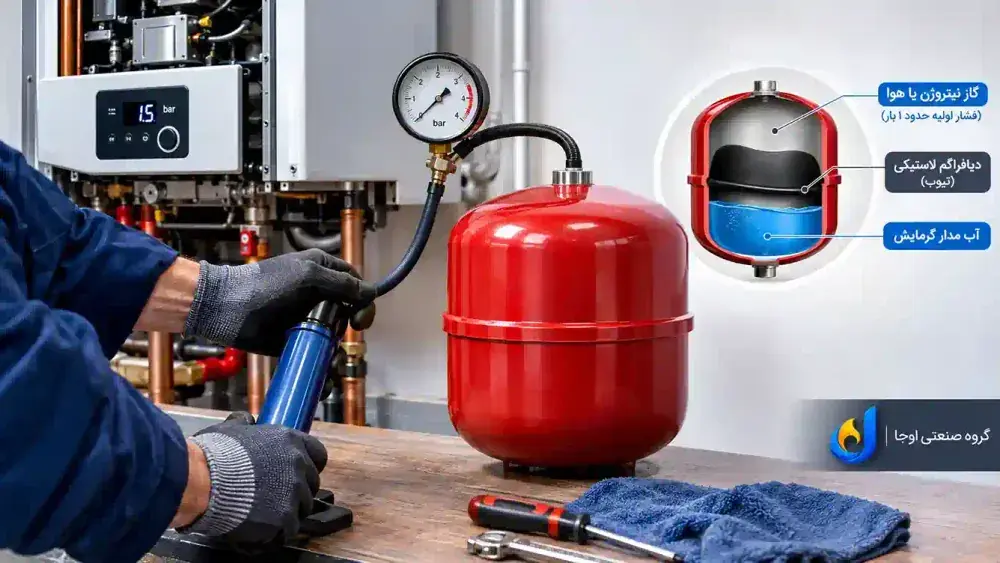
Encountering severe bar fluctuations and constant pressure drops in wall-hung combi boilers frequently directs technicians toward the boiler expansion vessel. This vital component absorbs the volumetric expansion of water as it heats up within the primary heat exchanger. When an expansion vessel loses its pre-charge air or suffers a ruptured internal diaphragm, the system's hydraulic equilibrium collapses, resulting in constant lockouts or safety valve discharges.
What is a Boiler Expansion Vessel and How Does It Work?
A boiler expansion vessel is a sealed metal container divided into two distinct chambers by a flexible rubber diaphragm (bladder). One side contains pressurized nitrogen or air (typically pre-charged to 1 bar), while the other side connects directly to the central heating water circuit. As the burner fires and water temperature rises, liquid volume increases. The expansion vessel compensates for this surge by compressing the internal air cushion. Absorbing Thermal Stress: Prevents extreme hydraulic pressure spikes during active heat exchanger operation. Maintaining System Stability: Keeps operating pressures stable, preventing the 3-bar safety relief valve from opening unnecessarily. Structural Variants: Manufactured in various configurations, including closed internal flat or rectangular expansion vessels mounted inside the boiler chassis.
Symptoms of Expansion Vessel Failure (Pressure Drops & Spikes)
Expansion vessel failure typically manifests in two primary ways: total loss of pre-charge air pressure or a completely ruptured internal bladder. Early identification prevents collateral damage across the hydraulic block. The most common indicators of a failing vessel include: Sudden Pressure Drops: As heated water cools down, the system pressure plummets to zero bar, causing frequent boiler lockouts without any visible external plumbing leaks. Severe Pressure Spikes: When the burner ignites, the pressure gauge needle rapidly shoots from 1. 5 bar past 3 bar, forcing the safety relief valve to discharge water. Water Leaking from the Schrader Valve: If pressing the core pin of the expansion vessel's air valve results in water spitting out instead of air, the internal bladder is completely ruptured.
How to Test and Recharge Boiler Expansion Vessel Air Pressure
Before replacing an expansion vessel, technicians can evaluate and recharge the air pressure using a standard hand pump and a digital pressure gauge. This procedure must be executed while the boiler is completely drained of water. The step-by-step workshop procedure includes: Complete System Drainage: Isolate electrical power and open the boiler drain cock to bleed all central heating water until the pressure gauge reads zero. Pressure Gauge Connection: Attach a pump and pressure gauge to the vessel's Schrader valve to measure the initial pre-charge air pressure. Adjusting to Standard Pressure: Set the vessel air pressure to between 0. 8 and 1. 2 bar, matching building height requirements; pump air if pressure is deficient. Evaluating Bladder Integrity: If the vessel fails to hold air pressure or water emerges from the valve, the component is unserviceable and must be replaced.
Workshop Checklist for Replacing a Boiler Expansion Vessel
When the internal rubber bladder suffers a puncture, repairs are impossible, and the boiler expansion vessel must be replaced with an OEM-spec component of identical volume. When purchasing and installing a replacement vessel, observe these rules: Volume and Dimension Matching: Vessels come in various capacities (typically 6, 7, or 8 liters); physical dimensions and port spacing must match the factory chassis. Replacing Sealing O-rings: Always install fresh O-rings lubricated with silicone grease when reconnecting the water pipe or mounting block. Chassis Access Constraints: Certain wall-hung models require removing the rear chassis panel or sliding the boiler forward; take extreme care not to pinch internal wiring.
Final Summary
The boiler expansion vessel plays a pivotal role in regulating volumetric water changes and preserving system pressure stability. Issues like wild gauge fluctuations or constant pressure drops during cooling phases are directly linked to lost air charge or bladder punctures. Technicians should always test and recharge expansion vessel air pressures before swapping expensive parts, restoring the combi boiler's hydraulic performance to factory standards.