Producing a stable, uninterrupted supply of domestic hot water in a combi boiler relies entirely on a highly compact, engineered component known as the boiler secondary heat exchanger. Because this part constantly interacts with hard mains water, it is extremely vulnerable to limescale accumulation and severe efficiency drops. Identifying the symptoms of a blockage early, and avoiding aggressive chemical treatments, is crucial to preventing the internal stainless steel plates from perforating and cross-contaminating the hydraulic circuits.
What is a Boiler Plate Heat Exchanger and How Does It Transfer Heat?
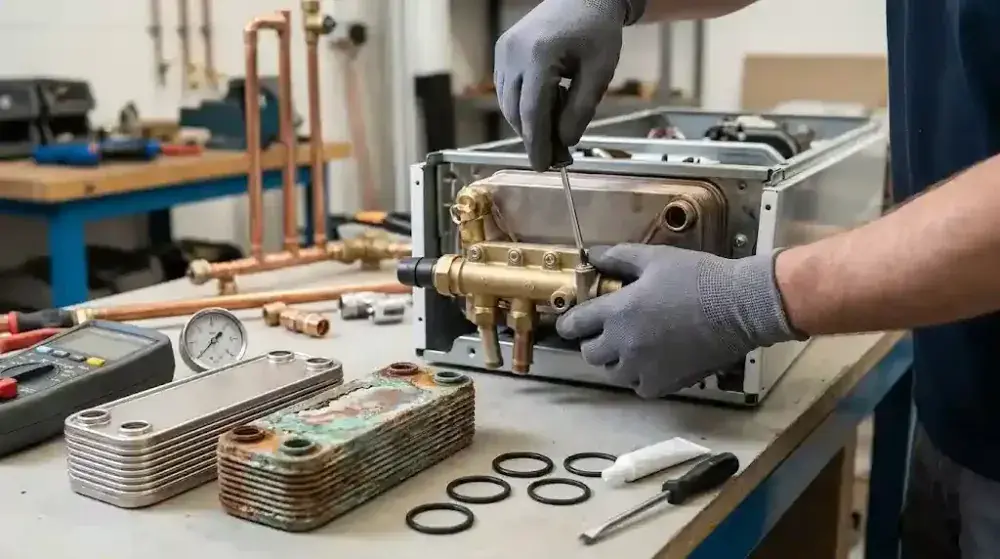
A boiler secondary heat exchanger (often called a Plate to Plate Heat Exchanger) consists of numerous thin, corrugated stainless steel plates brazed together with copper. This component features four distinct hydraulic ports and is mounted directly onto the brass or composite manifold. Heat transfer within this component occurs without the physical mixing of the two fluids. Parallel and Cross Flows: Extremely hot primary water (heated by the burner) enters one channel, while cold mains water flows through the adjacent channel in the opposite direction. Thermal energy passes instantly through the thin stainless steel walls. Total Fluid Isolation: The sealed structure guarantees that toxic, black central heating sludge never mixes with the building's potable domestic hot water. Determining Capacity: The number of plates (typically 12, 14, 16, or 20) dictates the thermal transfer capacity and the maximum hot water flow rate the boiler can sustain.
Symptoms of a Blocked Heat Exchanger and DHW Fluctuation
The microscopic channels between the stainless steel plates are prone to trapping calcium and magnesium minerals. A blocked heat exchanger completely halts thermal transfer, leading to severe thermal erraticism that the user notices immediately while showering. The most prominent indicators of heavy limescale accumulation include: DHW Temperature Fluctuations: Due to the thick insulating scale, the mains water fails to absorb heat. Consequently, the primary water boils, forcing the PCB to shut down the burner to prevent damage. This endless cycle of firing and shutting down causes severe hot and cold domestic hot water (DHW) fluctuations. Restricted Hot Water Flow: If the scaling is severe enough to physically obstruct the mains water channel, the hot water flow rate at the taps drops dramatically, eventually failing to trigger the flow meter. Localized Boiling Noises: Mineral buildup causes localized boiling within the plates, generating loud whistling or knocking noises from the hydraulic block when a hot tap is opened.
The Risks of Internal Perforation and Rising Boiler Pressure
One of the most catastrophic, yet silent, failures in a combi boiler is the internal perforation of the plate heat exchanger. This usually occurs due to galvanic corrosion, the natural end of its lifespan, or the frequent use of highly aggressive hydrochloric acid washes. Identifying a perforated plate requires careful observation of the boiler's hydraulic behavior. Cross-Circuit Contamination: If the internal wall between the channels develops a pinhole, high-pressure cold mains water bleeds directly into the closed central heating circuit, causing the pressure gauge to rise constantly even when the boiler is off. Safety Relief Discharge: As mains water floods the heating circuit, system pressure rapidly exceeds 3 bar, forcing the safety relief valve to repeatedly discharge water (a symptom nearly identical to a passing filling loop). Unrepairable Damage: Once a plate heat exchanger is punctured internally, it cannot be welded, patched, or repaired; the component must be permanently scrapped.
Workshop Guide for Safe Replacement vs. Acid Flushing
Many technicians attempt a boiler acid flush on the secondary heat exchanger to save the customer money. However, utilizing harsh descalers often strips the copper brazing between the plates, inevitably leading to catastrophic leaks shortly after reinstallation. To maintain professional workshop standards, adhere to the following protocols: Prioritize Replacement Over Flushing: In cases of severe blockage, replacing the unit with a brand-new, OEM-spec component matching the original plate count is the safest method to prevent future internal ruptures. Mandatory O-ring Replacement: This component mates to the flow and return hydraulic blocks via four EPDM O-rings. During installation, using brand-new O-rings lubricated with pure silicone grease is absolutely mandatory for a watertight seal. Even Torque Application: When securing the Allen or Phillips retaining screws, tighten them in a diagonal pattern with gentle torque to avoid crushing or deforming the rubber seals against the manifold.
Final Summary
The boiler secondary heat exchanger is the engine of domestic hot water production. Issues such as restricted flow rates, boiling noises, and a continuously rising pressure gauge are directly linked to plate scaling or internal perforation. If you are investigating DHW temperature fluctuations, diagnosing the plate heat exchanger is always the primary step. To prevent the dangerous cross-contamination of heating sludge with drinking water, avoid aggressive chemical acid flushing and always opt to replace a severely blocked component with a genuine new part.